Showing posts with label Rwanda Ejo Heza. Show all posts

Monday, April 20, 2020

COVID19 Images from Kopakama Cooperative

Strict movement restrictions were implemented starting March 23rd in Rwanda.
April 6 - general assembly for the cooperative had
 to be only the essential few officers, sitting 2 m apart.

Here is what Gervais KAYITARE, Executive Director of Kopakama Cooperative had to say when the lockdown started on March 23:
"The Government took further preventive measures against Coronavirus today. No movements are allowed between Kigali and rural areas nor between districts. For agricultural activities,  we are still allowed to collect cherries. I'm preparing the guidelines for farmers, collectors, reception, etc in order to meet the preventive measures."
Regarding farmers, he shared, 
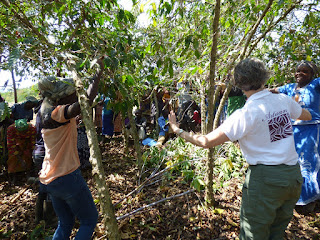
Modeling masks -
head agronomist, Justin, and
Ejo Heza farmer, Marie Grace
"like others in the World Wide, members of Kopakama are frightened of the pandemic. Because of restrictions, as rural people who live by daily routines, I can't say they feel safe because they're not free to move for satisfying their needs. Despite that they remain calm since they don't have any choice and nothing to do except respect of preventive measures proposed by the Government."
Seems like we will all be happy for Coronavirus to be under control so we can visit again!

See below for the March 23rd announcement from the Minister of Agriculture in Kinyarwanda.


Friday, March 1, 2019

Cherry Price and Farmers' Benefits

Farmer Field School – Abichizahamwa group
March 1, 2019

Today marks the day the National Agricultural Export Development Board (NAEB) will formally meet with about 100 owners of washing station in Rwanda and announce the "opening" floor price for cherry. They are setting it at an astonishingly low 190 Rwf/Kg cherry. That converts to about $.62/lb green and it is 36% less than the 300 Rwf/kg cherry ($1.07/ lb green) shown to be needed by farmers to incentivize best practices for coffee cultivation.

Several large exporters, however, are heavily invested in selling low-grade, fully-washed coffee. This is a product for which Rwanda cannot compete on a global stage against competitors from Brazil, Colombia and Ethiopia. These exporters drag down the cherry price and retard the entrance of the entire Rwandan coffee sector into a new age where Rwandan coffee is recognized as the "Panama of Africa." 

The benefits to farmers are significant when exporters agree to pay a rational share of the FOB price as the cherry price. Artisan contracts require that farmers are paid at least 300 Rwf/Kg cherry, and we have documented the following benefits over the past year:

Farmer Field School – Abichizahamwa group: 6 men, 24 women
The Ejo Heza members in the FFS were asked if they remembered anything special that happened at the last general assembly. They remembered receiving the premium. Then the agronomist asked if anyone would like to share what they did with their premium. (Names changed.)

Valerie MUKASHIMANA
Rec’d 53,000 Frw (~ $60) premium from Artisan. She was able to buy 3 bags of cement and put pavement in the floor of one room - the dining room in her home. She wants to improve the taste of her coffee so that “we can continue to develop.”

Dorothe MUBARAGA
Rec’d premium of 12,400 Frw (~ $14). She bought chickens and hired a person to help her weed the coffee and the beans that she grows. Got the money when it was a ‘bad situation’ (poverty and hunger) in our community. Helped my family very much.

Marie MUKAHERESHIMA
Rec’d premium of 55,000 Frw (~$62). It helped her to buy another cow from which she can use the manure to fertilize her coffee organically.

These amounts of cash mentioned above can be verified in the list of 320 names showing that each woman signed for their premium on October 31, 2017. (A similar list is now available for the 2018 premium.) The premiums from roasters are impacting these women’s lives and motivating them when we explain new tasks and efforts we’d like them to try to improve quality and consistency, and avoid potato-taste defect.

Want to learn more about how powerful premiums are? Listen to one of two interviews with Bette UWIMANA - posted on-line in 2018:
Short one – CLICK HERE.
Long one – CLICK HERE.

To summarize, here are paraphrases of comments from Ejo Heza members Bette UWIMANA, Martha Uwiherewenimana and a comment from the male members of Kopakama:
* Bette says the women of Ejo Heza were very happy. She said that the primary uses of the extra money were school fees, purchase of small animals (goats, pigs, chickens), and the fee to be enrolled in “Mituel”, the national health insurance. 
It inspires young, ambitious farmers to invest deeper in coffee and take on leadership roles. Bette Uwimana and her husband are a good example of this. Bette is 28 years old. She and her husband have 2 children, 8 and 4 years old. They’ve benefited from coffee for over five years, but only last year (2017) decided to join Ejo Heza. I suspect seeing the women receive the premium was the “decision-maker” for Bette. She has been on the staff at Kopakama for several years, seeing how the Ejo Heza women improve their production, and then seeing the premium she finally decided to join. She and her husband have 1,650 trees. Thus the impact of the premium is both individual and community: capacity building for Bette and new, young leadership for the Ejo Heza group. 
*Speaking to Martha Uwiherewenimana, the new president of the Kopakama cooperative, she personally appreciated receiving the premium last October and knows that the Ejo Heza women were amazed to receive this extra money directly in their hands. She is confident that premium will do much to overcome any objections to testing some new practices Artisan is suggesting to improve quality, (e.g. floating cherry to separate out floaters before paying the farmers).
Appreciation - even from the men: When a group of male and female Kopakama farmers were asked (during a field school) whether conflicts or jealousy developed when the women of Ejo Heza received a premium, a male farmer answered. He said he was proud of his wife for being an Ejo Heza farmer, since that meant their household received a premium. If she had not been a member, the household wouldn’t have received any premium last year. (The cooperative normally pays a second-payment to all members in January, but in Jan. 2018 the members decided to pay down the loan they took out to build the dry mill.)

Saturday, December 1, 2018

Ejo Heza Women Celebrate and say "Thank you!"

Ejo Heza General Assembly at KOPAKAMA Mushubati station, Nov. 30, 2018
Nov. 30 was the one of the best days of the year for 320 coffee farmers and their families in Mushubati cell, Rutsiro district, Western Province, Rwanda. Yesterday was the date of the annual general assembly for the Ejo Heza group of women, which is a sub-group of the well-established Kopakama cooperative. Perched on top of a mountain, in the building that doubles as meeting room and coffee warehouse, (depending on the season), the members of Ejo Heza gathered. Three of their officers led the proceedings: chairperson Therese UWIMANA, vice-chair Beatrice TUYISABE, and secretary Olive NYIRAGAHIGIRWA.

Each woman received $.136/lb green coffee sold by Artisan Coffee Imports. They receive cash in their hand, calculated based on two factors:
1. the KG of cherry they delivered from their "own trees" from near their home, and
2. their share, according to the days of work they contributed to the Ejo Heza cooperative plots of land.

This 'second payment' comes on top of the $1.078/lb green they receive as the 'first payment' or base price for their cherry. In other words, roasters who buy Ejo Heza helped those farmers have 13% bonus, a total of  $1.214/lb green. For this, they are grateful, as you can see in this video of them dancing and singing!

The 'first payment' the farmer receives is the larger of the two and an important signal to the farmers of how much the washing station is willing to pay to attract the farmer's loyalty, and also a signal of what quality level the washing station requires. Washing stations that expect more selective sorting prior to delivering cherry will pay more than those stations that don't care and buy everything.
Farmers bring cherry to the washing station to sell - usually transporting by foot.
Weighing cherry - preferably within 6 hours of it being picked from the tree.

A farmer watches as her Kgs of cherry and the corresponding price are recorded.

For Ejo Heza farmers, the process of bringing cherry to the washing station is part of what solidifies their unity and strengthens the sense of belonging for each woman. Ejo Heza cherry is only collected on one, sometimes two, specified days of the week. This allows the washing station to keep the "women's coffee" separate from the rest and sell it as women's coffee. So the women know when they bring their cherry that they are contributing to this specially selected batch, and this brings a sense of honor and duty. Their coffee won 8th place in Rwanda's Cup of Excellence in 2018!
Ejo Heza members sort cherry harvested from their community field on a Tuesday - the day for women's coffee.

The second payment from a cooperative is solidifies the loyalty of the farmers, and is the way the cooperatives shares it's 'profits' after costs and revenues for the year have been finalized. The timing of the payments can be a benefit to farming households as they come 6 months after the season has ended, when cash may be low.
Proceedings at the Ejo Heza general assembly, 2018.
We don't have the lists and other details from last week's meeting yet, but in August 2018, Artisan's Ruth Ann Church visited one of the farmer field schools (FFSs) with 24 Ejo Heza members (and 6 of the cooperative's male members). Church asked and a few of the women were willing to share what they did with the premium they received the year before. There among the coffee trees, they quietly stood and shared these short stories, firmly and with pride. (Names have been changed.)

Charlotte HABIRIMANA
Received 53,000 Frw (~ $60) premium from Artisan. "I was able to buy three bags of cement and put pavement in the floor of one room - the dining room of my home. ...I want to improve the taste of our coffee so that we can continue to develop.”

Danielle KARENGERA
Received premium of 12,400 Frw (~ $14). "I bought chickens and hired a person to help me weed the coffee (and the beans?). I got the money when it was a ‘bad situation’ (poverty and hunger) in our community. It helped my family very much."

Grace MURIZANA
Received premium of 55,000 Frw (~$62). "It helped me to buy another cow from which I can use the manure to fertilize coffee."

These amounts of cash mentioned above can be verified in the list of 320 names showing that each woman signed for their premium on October 31, 2017. (Click here to request the list.) The premium from every roaster is impacting these women’s lives. They are motivated to work with us as we explain new tasks and efforts we’d like them to try to improve quality and consistency...and avoid potato-taste defect.

Friday, June 29, 2018

Ejo Heza Women Dancing During Field School

June 29, 2018
During my field visit yesterday to Sure, where the Ejo Heza women were preparing the land for the next season, they gathered at the end for a short field school lesson on pruning. Agronomist Justin gave a short talk, demonstrating proper pruning technique, then asked Ruth Ann to stand and share some comments. She briefly shared her appreciation for all their work, and announced the number of bags Artisan would be purchasing in the coming year. The women, all 40 - 50 of them, reciprocated with a chant, expressing their dignity and purpose as a group of female coffee farmers. Then they celebrated with several dances and songs! It was loud, joyous and beautiful!

 CLICK HERE to hear the women's mantra (or click photo below).
https://www.youtube.com/watch?v=Fis_OyOC9Zg


CLICK HERE for the very short video (technical difficulties) or click one of the photos below.

https://drive.google.com/open?id=1hSKCFioKuOy-TeqKSYQBEJxugH6AxDkW

https://drive.google.com/open?id=1Zg1X-rKhTYNpkfVkchEuozps-JHwmupc

Saturday, June 23, 2018

What Bette UWIMANA would like to tell you...

Bette Uwimana, one of the leaders of Ejo Heza.
Yesterday I had the honor to visit Kopakama with green coffee buyer, Aaron Van der Groen from Ritual Coffee in San Francisco, CA. We were both glad that Bette UWIMANA, a leader of the Ejo Heza women's cooperative, happened to be at the washing station that afternoon.  Bette, 28 years old, recently joined the cooperative with the objective to improve the production from her coffee trees. She's accepted a leadership role as manager of credit and loans for the group's microcredit program.

Aaron asked, "what would you like to tell our customers who drink your coffee?"

CLICK HERE to open a Youtube video and listen to Uwimana's answer in her own words (translated from Kinyarwanda to English by Gervais Kayitare).

Brief summary: "what I can say to our clients is that we hope they continue to build their relationships with our farmers so that we can increase our production. Another thing, we will continue to receive their advice related to the quality of our coffee." 

L: Kayitare, R: Uwimana

L: Uwimana, R: Van der Groen
L: Church, R: Uwimana


Monday, June 11, 2018

Roaster of the week: Blueprint - Telescopes and Microscopes

Blueprint team meeting - front of store!
Blueprint Logo
In 2013 four co-workers at a different St. Louis coffee roaster, left and founded a new coffee roasting company with a new vision: Blueprint Coffee. The tag line, "beauty in precision" speaks to the passion the owners have for "honing every aspect of the coffee producing, importing, roasting and brewing process," states Andrew Timko, one of the five total owners today. His "co-members" as they call themselves, are Mazi Razani, Kevin Reddy, Mike Marquard, and Brian Levine.
Blueprint's overall Green Buying Partnership Vision is to promote shared risk and improved data sharing between the producers and Blueprint Coffee, creating a kind of "telescope" from the cafe counter in St. Louis, Missouri, to six inches into the soil of every farm growing their coffee! It's not every day that you meet people who are so into coffee, that soil is as interesting as outer space! But that is the case with Timko, Razani, Reddy and Marquard. And it actually makes a lot of sense when you hear someone like Timko explain it. "Coffee quality doesn't start with the bean, it starts with the soil the coffee plant is growing in."

Timko describes his vision of having digital tools that allow him as a roaster in St. Louis, to get regular readings on soil moisture and soil micro-organism counts on the farms that grow the coffee they buy half a globe away - year 'round. They may be a few years away from that being a reality, but they are definitely working towards it step by step.

The focus on brewed cup quality and a chill space to relax and enjoy coffee is equally strong. They've won awards from Good Food Awards for one of their single-origin coffees and from Architectural Digest for their space.

Blueprint's search for authenticity in everything they do is literally what led them to Artisan Coffee as their importer for Rwandan coffee. Timko was trying to understand the history of specialty coffee in Rwanda and stumbled onto the story of the PEARL project, which launched Rwanda's rise in the coffee world in 2003. This led him to Michigan State University websites, which eventually led him to get in touch with Ruth Ann Church, who was studying under the director of the PEARL project (Dan Clay) recently. Her "student profile" mentioned she is a coffee importer.

So five years after the fabled start of Blueprint, amazing projects are gearing up. One involves a microscope. It seems a microscope would be more beneficial than a telescope for the women of Ejo Heza, the sub-group at Kopakama cooperative that grows the coffee Blueprint buys. Watch this space, as the concept of a great cup of coffee may include helping coffee farmers monitor their soil with microscopes!


Monday, April 30, 2018

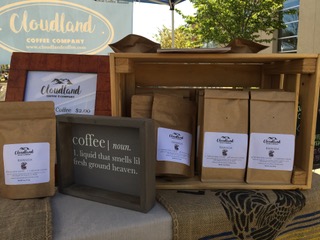
Roaster of the week: Kristina Madh - Cloudland Coffee

Roaster Kristina Madh and I connected on several levels when we met at CoffeeFest Baltimore.
Serving and showing Rwandan beans.

I was amazed with her story of opening her micro-roaster company, Cloudland, in Atlanta, Georgia on pure guts, passion and inspiration! She found a space in a shared kitchen where the other entrepreneurs, bakers and other culinary folks, don't mind the aroma of roasted coffee in the air. Then she found customers at the farmers market, on the web, and elsewhere in town. Her customers are people who seek out great-tasting coffee and appreciate businesses like Cloudland, which source their coffee with care for social consciousness and positive impact for the producers who grow the coffee. "Fair trade and beyond" is one way to put it.
Kristina puts it this way on Clouldland's website: We strive to responsibly source our coffee from importers who engage with coffee farmers through programs including Fair Trade, Sustainable Farming Practices (including organic farming), the Women Coffee Producers program and more. Our coffee comes from smaller lots and is seasonal, so you will see a rotation of our coffee throughout the year.

The fact that the producers of this Rwandan coffee are the women of the Ejo Heza cooperative adds an extra "sweet note" for Kristina to this coffee's fruity, berry-like flavors. As a female roaster, she has experienced how the male-dominated coffee industry can ignore women's skills and contributions, but she has also seen how the industry as a whole is moving fast to embrace and empower female professionals in the supply chain. Kristina and I are both proud that this coffee is an example of this good direction, given the traceability to females at the farm, and at the importing, roasting and brewing stages. Way to go, Cloudland!

As Kristina serves up this aromatic coffee at the Farmer's Market in Atlanta, her customers tell her they love the cup! Many also love the story and the satisfaction that Kristina can assure them that the coffee producers received their premium payment. (Click here for a throwback post on that topic.)
Rwanda packaged - who wouldn't want to buy some heaven?!

Farmers' market display.


Friday, March 23, 2018

Roaster of the Week: Dessert Oasis and Nathan Hamood

Mar. 23, 2018

Roaster and Co-Owner Nathan Hamood
"Dessert Oasis" has got to be one of the best names for a cafe I've ever heard. Who wouldn't love to go to a "dessert oasis"?! So we are thrilled to send our roaster shout-out this week to Nathan Hamood and his crew at Dessert Oasis in downtown Rochester, Michigan this week! The company is family-owned. Nathan's parents ran the business before he "came of age" and started moving the coffee menu towards its current firm footing in the specialty arena. Nathan is the roaster and director of coffee for their two locations, one in Rochester and one in Detroit (1220 Griswold, near Capital Park) and a soon-to-be third location in Royal Oak! He carefully curates the coffees, looking for single-origin coffees with brightness and complexity that is striking and pleasant. From the tables filled with happy customers mid-day, it was my impression that he has many people appreciating his tasting and roasting skills!

In short, they live up to their mission:
We strive to deliver an unrivaled coffee, dessert, and entertainment experience through close attention to detail, an unbelievable knack for quality, and intense love for our communities.

The namesake dessert case - mouth-watering!
One example of the Dessert Oasis offering is the Rwanda Ejo Heza from Artisan Coffee Imports. While there, I also got to taste the Kenya AA Karimikui, Gichugu, Kirinyaga county. Nathan says he has no problem filling half his menu with East African coffees if they are good coffees. He doesn't try to balance the number of S. American, Asian and African origins as some roasters do. This kind of purist dedication to single-origin taste promotes great conversations between the baristas and customers who want to know more.

Nathan roasts on a US Roaster, 3 kilo machine, carefully monitoring computer read-outs of his profile. He said he gives the Rwanda Ejo Heza a light roast, being sure to monitor it carefully after the first crack with very low heat.

The Dessert Oasis company has a wonderful team, including baristas Tyler and Olya, whom I got to meet the day I was there. They all seemed skilled at latte art, which shouldn't be surprising since the company also regularly hosts latte art throw-downs. A recent throw-down was "very successful" in Nathan's words, drawing 60 contestants and 200 attendees.

The business maintains an emphasis on live and local music with frequent concerts on its mini-music stage, an offering of CDs from local artists and music-themed decor.

Hats off again to Dessert Oasis for creating a great place for coffee, dessert and music. Thank you for offering your customers Rwanda Ejo Heza!

Nathan (L) and barista Tyler (R)

Live music is a theme at Dessert Oasis - helps create community!


Wednesday, March 7, 2018

Roaster of the Week: Peet's Celebrates Women in Coffee

Mar. 7, 2018
Our roaster of the week this week is Peet's Coffee!

Some call him the "godfather" of specialty coffee - Alfred Peet certainly holds a very special place in the history of coffee. He founded Peet's Coffee in 1966 in Berkely, CA.

Today, Peet's is ahead of the rest with a massive Celebrate Women in Coffee promotion of the United Nation's International Women's Day 2018 on March 8, 2018.  Peet's is offering a Sisterhood Flight Collection of three types of roasted beans from three countries: Rwanda, Colombia and Nicaragua. Their website lists the locations across seven states and Washington D.C. where the special collection of coffee can be purchased, and they give a step-by-step recommendation of how to throw a tasting party with your sisters!

There is another part of this promotion that we at Artisan Coffee love even more than all that goodness - Peet's has named the International Womens Coffee Alliance (IWCA) and their Research Alliance as the beneficiary to receive 10% of all proceeds! Well done, Peet's. The Research Alliance is a volunteer group that brings together researchers who accelerate credible research results on gender issues in coffee that are otherwise side-tracked or ignored. So please, dear blog readers, go out and buy some! If it's not possible in your area, keep reading... there's another great option to support female coffee producers!
Women of the Rwanda Ejo Heza coop holding coffee cherry.
To their credit, Peet's is supporting women in coffee in ways that are less well advertised, too. We hope it is "cool" on this special International Women's Day to share that the buying team at Peet's chose Rwanda Ejo Heza women-grown coffee to go into their great-tasting "Uzuri Blend." Uzuri means "beauty" in Swahili. The Uzuri has a long-standing tradition in the company, as it represents many projects supporting coffee producers that Peet's has supported in East Africa for years. Starting this year, the blend includes the hard-won and delicious results of the Ejo-Heza sub-cooperative, which Artisan Coffee Imports was able to offer Peet's.

A Visit to Peet's HQ

Artisan's president, Ruth Ann Church, was able to visit the Emeryville headquarters of Peet's and witness first-hand how the "Berkley-esque", mid-60s roots of the company still permeate the offices, mixing well with modern renovations and updates. They're waving the flag of diversity in many ways, incorporating a love of Americana by naming the open-conferences areas with names of famous regions and labeling the rows of office cubes with well-known streets in San Francisco, like Vine, Fourth and Solano. I was impressed with their large, newly-opened demonstration cafe, fully equipped and ready to help customers immerse into the Peet's Coffee experience!

Map of the Bay Area in the lobby. (Not Europe!) Sean Coutts, Green Coffee Buyer, shows Peet's location.

Ruth Ann in the customer experience area.
Passageway painted to feel like a coffee farm.

Diversity always.

Sign posts in "cube city" keep the culture fun and help you find your co-worker!
Next visit, Ruth Ann hopes to tour the roasting facility. It is a completely separate building!