July 8, 2019
 |
| Dukunde Kawa Musasa drying tables offer a spectacular view of Gakenke district mountains. |
In Rwanda, you often see four armed soldiers or policemen walking single-file on the side of the road. They walk slowly, as if they have all day to get where they are going and they know they have to walk many miles. I often wondered whether the objective is 1. to be seen on the roads or 2. to get where they are going. Today I learned that at least sometimes, it is to "get where they are going." I stopped at a dusty mountain intersection to ask directions from a civilian, and the lead soldier in a group-of-four walked up to my car and said they needed a ride. Next thing I knew, I had three soldiers with machine guns in my back seat (my translator in the front passenger seat) and the 4th soldier was crouched in the luggage space of my Toyota Rav4 with knees to his chin!
The above scenario is a metaphor for the way Rwandan coffee is also beginning to "get where it is going" by using machinery. For the soldiers, a half-day's walking journey, became a 15 minute, somewhat cramped, car-ride. At Dukundekawa Musasa in Gakenke district, I saw how a forward-thinking cooperative of farmers is investing in machinery to take them where they are going faster.
Since my first visit to Dukundekawa in early 2016, I've returned at least three times. Each time I see new investments in machines. [1]
What Dukundekawa is doing is eliminating waste. They are doing so without knowing that they are demonstrating
Lean at Origin principles. (Refer to our "
Resiliency Coffee" blog and search on "Lean" to learn more about Lean at Origin.) Here we will share the unique machines that Dukundekawa has brought on-line and name the wastes that these machines will help eliminate.
 |
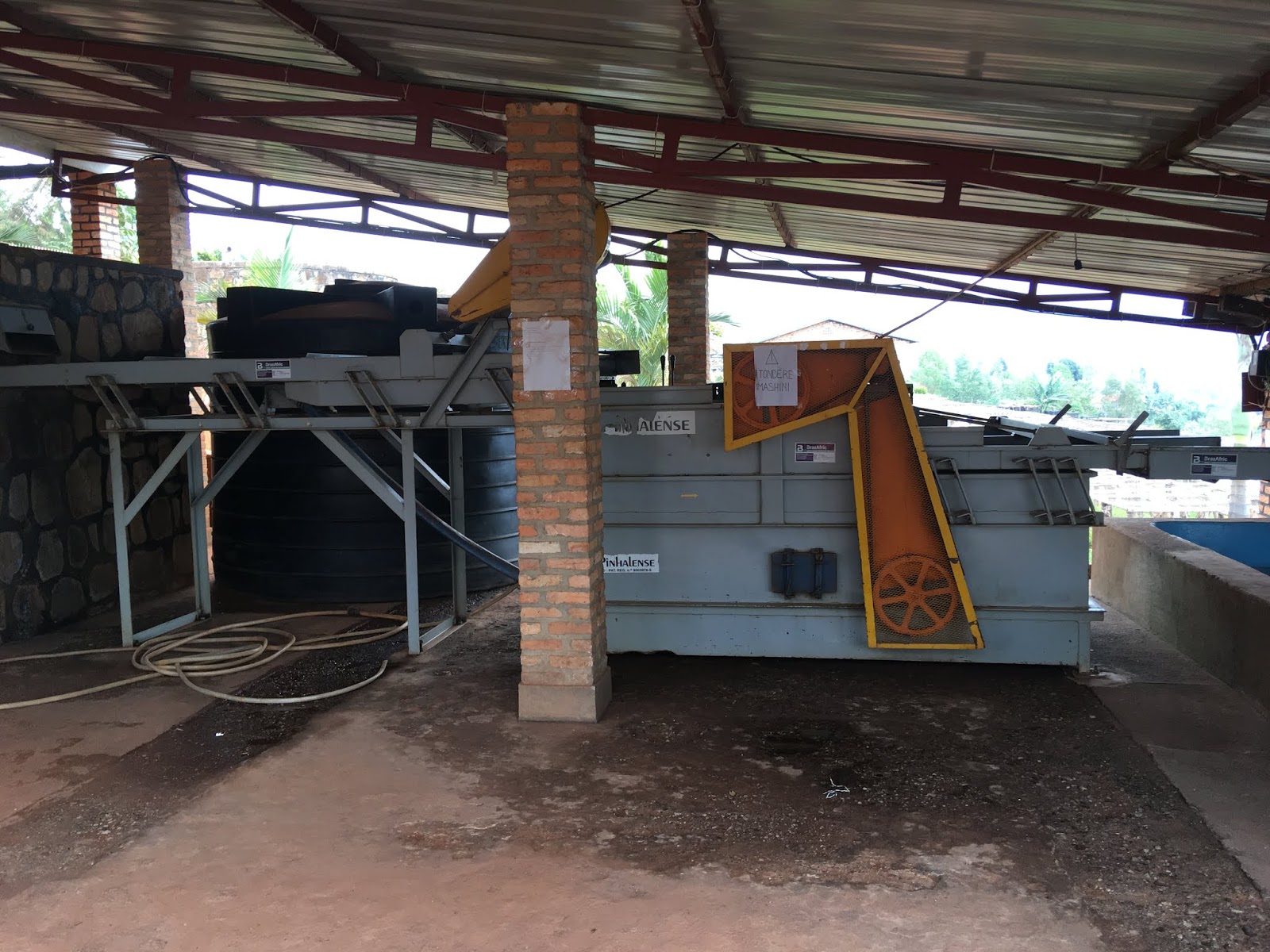
| Pinahlense 11 MT cherry sorter. |
1. The Pinhalense cherry sorter was first used in the 2015 season, and fully implemented before the 2016 season started. This machine eliminates
defects (one type of waste) by sorting cherries by density that have just been delivered by site collectors. Site collectors bring large volumes of cherry to the washing station. One site collector might arrive with as much as 800 kg. The cherry sorting machine uses gravity, water and floatation. The machine's channels shake and have holes in the bottom to separate the dense (good) cherry from the light (bad) cherry, sometimes called "floaters." The two types are moved into a different chutes. Dukundekawa staff can easily measure the weight of the floaters of any site collector's delivery. The agreement signed with the collector is that if any delivery has more than 1% floaters, the entire weight of floaters will be deducted from his service pay. In the 2019 season, only one collector over-stepped the 1% mark for allowable floaters. Apparently, the threat of a monetary fine is usually good enough to ensure site collectors are strict with quality control at their site.
 |
| Looking left. |
 |
| Above: Looking right. Entrance to reception area is designed for easy access of trucks and farmers. |
2. In 2015 Dukundekawa re-constructed the
entrance to the receiving area for cherries. They eliminated wasted
transportation of material and wasted
motion of people by thinking about how to allow trucks and farmers carrying heavy sacks on their heads to get as close as possible to the scale for weighing their delivery. The ramp from the main road (top photo) slopes down and curves towards the reception area, which can be seen straight ahead in the bottom photo. (Under the roof shown in the bottom photo is where the cherry reception process starts.) The improved access saves the steps of workers and farmers who spend hours of back-breaking labor at other washing stations to move heavy sacks up stairs, around columns and over bumpy, steeply sloped terrain to unload trucks or just arrive on foot. While not yet documented, it's possible that the improved access has shortened the lines during peak season, eliminating
waiting, another type of waste.
 |
| Outside of dry mill |
 |
| Inside the dry mill. |
3. In 2016, Dukundekawa built
a dry mill -- right across the street from the washing station (wet mill), establishing one of only a handful of dry mill functioning outside of the capital of Kigali and bringing a significant industrial process to their rural mountain village. Besides increasing the number of skilled and unskilled laborers employed during the season, the dry mill had all the benefits the cooperative management had been longing for: more control over export preparation of their semi-finished product, parchment coffee. The new dry mill eliminates
defects by allowing the coop direct control of machine maintenance, settings and storage. It eliminates
unnecessary processing steps by allowing the coop to skip steps in the milling process if they are not required by a customer order. It eliminates
waiting, because in Kigali the cooperative's trucks of parchment could wait days or weeks for "their turn" to be processed. It eliminates wasted
transportation of material, wasted
inventory, and wasted
motion of people. Clearly, the investment in a dry mill helps Dukundekawa eliminate wastes of many kinds, and the associated costs, for all future seasons, while at the same time increasing quality. It is a strikingly good example of Lean at Origin management.
 |
| Manager Isaac with drum dryer |
4. In 2018, Dukundekawa purchased a mechanical
drum dryer for more speedy drying of low-quality coffees. This dryer eliminates
defects to high-grade coffee that occur when space on raised tables is lacking, and quality grades therefore get stacked too high or worse - left waiting in a tank too long. It also eliminates
waiting, transportation of material and
motion of people. Without a drum dryer, washing stations are forced to dry low-grade depulped coffee on drying tables, taking up valuable real estate for higher grades, or dry the low-grades on plastic sheets spread on the ground. Drying on the ground is unsanitary for the coffee, lengthens the process and involves several additional movements of material and people. However, the real beauty of being able to whisk low-grade coffees into a mechanical dryer is the additional
space gained on raised beds for the high-quality coffees, especially during peak season.
 |
| Two new coffee elevators (l and r) and the new Sortex color sorter from Buehler. |
 |
| Rwanda's only Buehler Multi-vision Sortex B now resides at Dukundekawa's dry mill. |
5. Now, in 2019, Dukundekawa is in the final installation stages of a
Multivision Sortex B color-sorting machine from Buehler. The main waste eliminated by this machine is
defects. Olivier, the installation technician from Brazafric, explained to me that the Multivision uses three wavelengths and can therefore detect colors that other (two-wavelength) color sorters in Rwanda cannot. Importantly, they believe they have shown in tests that discoloration from insect damage, not detected by two-wavelength machines, will be identified and rejected by the Multivision model. This capability has the potential to significantly reduce potato taste defect in Rwandan coffee, which has been shown to be highly correlated with antestia bug infestation (
click here for the paper).
 |
| 6 new conveyor belts for sorting green coffee. Automated movement to the "mixing silo" at the back. |
 |
| Workers will be able to sit during their 7 hour day and sort the green coffee under UV lights. |
 |
| Chairs where hundreds of women will be able to sit, instead of sitting on the floor to do their job - improving worker conditions, avoiding injury. |
6. Also this year, Dukundekawa is installing
six new Pinhalense conveyor belts for sorting green coffee, connected to
automated transport to a mixing silo. The new equipment and chairs will eliminate waste from
defects, waiting, transportation of material, motion of people and inventory. This new process is an advancement and transformation from the traditional hand-sorting method. In most dry mills in Rwanda, you will find a giant hall like the one pictured above, with hundreds of women (and a few men) sitting on their scarves, stretched out like a blanket on the floor. They will have one or two of the plastic bags used for transporting parchment flattened on the floor next to them, on which you will see two or three piles of green beans: the unsorted pile, the "good" pile and the "bad" pile. They work for 7 hours a day. In the dry mill I know best, there is a supervisor who walks around to all the women checking their work, letting them know when/if the "good" pile is good enough to move on to the next bag. [2] Once their "good pile" is approved, each worker has to carry that pile of beans to a different place in the hall, and the "bad pile" or waste beans to even a different place (see spaghetti diagram below). Clearly there is wasted movement of material and people, much waiting for a supervisor and potential for human error under such conditions. Dukundekawa has changed all that.
 |
| A so-called "spaghetti diagram" of the traditional hand-sorting process helps visualize the wasted movement of people and material. (The steps of each worker are dotted lines that look like a plate of spaghetti.) |
7. A highly valued resource for every coffee producer, however, is a fully equipped and on-site cupping lab. Cupping labs allow a trained cupper to evaluate the quality of each lot of coffee, and thus enables the producer to know the potential value of their crop. Dukundekawa is already advancing from their first on-site cupping lab to a new, still-under-construction, state-of-the-art cupping lab that will likely qualify for Specialty Coffee Association certification.
 |
| Outside the old cupping lab - this one to be discontinued this year. |
 |
| Inside the old cupping lab. |
 |
| New, quite large, state-of-the-art cupping lab under construction. |
With a cupping lab, old or new, producer groups are able to go much further with understanding the quality and thus the value of their coffee. They can work more strategically to
eliminate defects in all parts of the production system.
My ride with the soldiers ended happily for everyone, by the way. I invited them to try the brewed coffee I had just purchased at Bourbon in Kigali and kept warm in a thermos. I had little thermal cups (typically used when I serve farmers) and we all stood around enjoying a nice coffee break with Rwandan coffee!
[1] This is the first time I've arrived at Dukundekawa as a buyer. Prior visits I was wearing only my researcher hat. This year Artisan Coffee Imports will import just a few bags of Dukundekawa's Rambagira group women's coffee. Rambagira coffee is from Dukundekawa's female members and it is collected on Wednesdays during harvest. Then it's kept separate throughout processing and export.
[2] The usual rate of work is 30 kg of green coffee sorted per person per day, for high-grade coffee. More coffee can be finished per day for lower grades.