Showing posts with label #payfarmersfairly. Show all posts

Monday, May 6, 2019

What to Pay for Coffee - Not So Complicated

May 6, 2019
Ejo Heza women's group in Rwanda - sorting cherry

Guest blogger Kathy Tian, MBA/MS 2020, Erb Institute at the University of Michigan and Ruth Ann Church, President, Artisan Coffee Imports

Let's say you're a coffee roaster. Is it complicated to know what to pay for your green coffee? Not so much. Drawing content from two panels at SCA Expo in Boston we synthesize why. Both of these panels rigorously researched costs in Colombia and Rwanda: two different countries and two different continents. In one panel, "East Africa Quality Innovation," Ruth Ann Church shared  the connectedness of marketing, price and quality in Rwanda. Guest blogger, Kathy Tian, spoke on a separate panel: "Implications of Specialty Coffee Farming Costs in Colombia." 

Recommendations to roasters boil down to three steps:

1. Ask your importer if their contract with the producer is a fixed price contract or based on the C-price? Hopefully the importer's answer is that your less-than-container-load of bags of microlot coffee were bought on a fixed price contract. For microlot purchases up to about 300 bags, (sometimes more), this usually possible. NYBOT C-price based pricing is necessary when the coffee volume is large enough to need hedging in futures markets.

2. Ask your importer what is the farmer paid? Hopefully the importer's answer is "we can tell you that no problem." And then they give you a $ per unit answer. If they give you a lot of excuses about how difficult it is to answer, try reassuring them that you can handle doing some conversions if they can't. But shouldn't an importer be able to do the conversions (from local currency to US$; from KG to pounds; from cherry to green)? For example, Artisan Coffee Imports shared the prices Kopakama's members received for the past three years in this chart during the SCA panel:
KOPAKAMA Coop
2016
2017
2018
2019 (projected)
Avg. farmer price* $/lb. green
$.70/lb
$1.02/lb
$1.07/lb 
$.80/ lb
farmgate + 2nd payment + premiums

If your importer seems conflicted or "over asked" when you inquire about the price to the farmer, there's a fair chance that he/she doesn't know. And there's a fair chance they would like to know also, but they have been deflected by their contact at origin when they try to find out. YOU can be the catalyst towards more transparency and education about where value is in the value chain. YOU, as the roaster, have a powerful position in this chain, no matter what your size. If your volumes are small, then your questions and your responses to answers may not change current business practices in the short term. But, when you ask the questions and urge your supplier to get clear answers from their supplier, your voice makes a difference over the long run.

Cherry harvest in Rwanda
3. What is your pricing philosophy? There are many things to consider when it comes to your pricing philosophy, including how much to anchor on the NYBOT C-price, and how much time and money you, the roaster, wants to invest  to understand costs. Also, how much you believe the farmer should be able to dictate their own price. Kathy Tian, based on her experience in Colombia, recommends focusing on the following two thought processes first, which may help simplify and clarify the roaster's approach:
1)      Think about today’s farmers and future farmers. Try to understand the opportunity cost for a young person in the origin country who can consider coffee farming against other options to earn a living.

An importer could potentially play a critical role in helping you achieve this part of your pricing philosophy. For example, perhaps your importer can share what the opportunity costs are of current and future farmers at origin. More than likely, a young person will have alternatives available to them in agriculture. A knowledgeable importer may be able to share the exact value of opportunity costs for you.  

2)      Think about the power that you have in your value chain to lower costs, other than the price paid to the farmer. If you are a small roaster sourcing exclusively from farms of <0.5 hectares, your ability to realize cost savings upstream is very limited. Instead, consider ways in which you could lower costs at the roaster level.
There are a few ways to lower costs at the roaster level. One opportunity is for small roasters to encourage medium size roasters that benefit from economies of scale in packaging, retail, and transportation fees to take action to address the needs of small holder farmers. This is currently happening in the industry but could be amplified to create more rippling impacts in coffee communities around the world. 
A second option is for small roasters to work together and share supply chains—collaborating on sourcing. This should reduce costs of exports and imports by guaranteeing larger order quantities, which can be passed on to the farmer. 
Alternatively, some small roasters seek out green bean importers who act as the consolidator of many small orders and transparently share the cost savings with the producers. "Transparently" in this case means the importer can tell you the dollars and cents per unit (e.g. per pound green) the farmers received. (See 2 above.) 

Friday, March 1, 2019

Cherry Price and Farmers' Benefits

Farmer Field School – Abichizahamwa group
March 1, 2019

Today marks the day the National Agricultural Export Development Board (NAEB) will formally meet with about 100 owners of washing station in Rwanda and announce the "opening" floor price for cherry. They are setting it at an astonishingly low 190 Rwf/Kg cherry. That converts to about $.62/lb green and it is 36% less than the 300 Rwf/kg cherry ($1.07/ lb green) shown to be needed by farmers to incentivize best practices for coffee cultivation.

Several large exporters, however, are heavily invested in selling low-grade, fully-washed coffee. This is a product for which Rwanda cannot compete on a global stage against competitors from Brazil, Colombia and Ethiopia. These exporters drag down the cherry price and retard the entrance of the entire Rwandan coffee sector into a new age where Rwandan coffee is recognized as the "Panama of Africa." 

The benefits to farmers are significant when exporters agree to pay a rational share of the FOB price as the cherry price. Artisan contracts require that farmers are paid at least 300 Rwf/Kg cherry, and we have documented the following benefits over the past year:

Farmer Field School – Abichizahamwa group: 6 men, 24 women
The Ejo Heza members in the FFS were asked if they remembered anything special that happened at the last general assembly. They remembered receiving the premium. Then the agronomist asked if anyone would like to share what they did with their premium. (Names changed.)

Valerie MUKASHIMANA
Rec’d 53,000 Frw (~ $60) premium from Artisan. She was able to buy 3 bags of cement and put pavement in the floor of one room - the dining room in her home. She wants to improve the taste of her coffee so that “we can continue to develop.”

Dorothe MUBARAGA
Rec’d premium of 12,400 Frw (~ $14). She bought chickens and hired a person to help her weed the coffee and the beans that she grows. Got the money when it was a ‘bad situation’ (poverty and hunger) in our community. Helped my family very much.

Marie MUKAHERESHIMA
Rec’d premium of 55,000 Frw (~$62). It helped her to buy another cow from which she can use the manure to fertilize her coffee organically.

These amounts of cash mentioned above can be verified in the list of 320 names showing that each woman signed for their premium on October 31, 2017. (A similar list is now available for the 2018 premium.) The premiums from roasters are impacting these women’s lives and motivating them when we explain new tasks and efforts we’d like them to try to improve quality and consistency, and avoid potato-taste defect.

Want to learn more about how powerful premiums are? Listen to one of two interviews with Bette UWIMANA - posted on-line in 2018:
Short one – CLICK HERE.
Long one – CLICK HERE.

To summarize, here are paraphrases of comments from Ejo Heza members Bette UWIMANA, Martha Uwiherewenimana and a comment from the male members of Kopakama:
* Bette says the women of Ejo Heza were very happy. She said that the primary uses of the extra money were school fees, purchase of small animals (goats, pigs, chickens), and the fee to be enrolled in “Mituel”, the national health insurance. 
It inspires young, ambitious farmers to invest deeper in coffee and take on leadership roles. Bette Uwimana and her husband are a good example of this. Bette is 28 years old. She and her husband have 2 children, 8 and 4 years old. They’ve benefited from coffee for over five years, but only last year (2017) decided to join Ejo Heza. I suspect seeing the women receive the premium was the “decision-maker” for Bette. She has been on the staff at Kopakama for several years, seeing how the Ejo Heza women improve their production, and then seeing the premium she finally decided to join. She and her husband have 1,650 trees. Thus the impact of the premium is both individual and community: capacity building for Bette and new, young leadership for the Ejo Heza group. 
*Speaking to Martha Uwiherewenimana, the new president of the Kopakama cooperative, she personally appreciated receiving the premium last October and knows that the Ejo Heza women were amazed to receive this extra money directly in their hands. She is confident that premium will do much to overcome any objections to testing some new practices Artisan is suggesting to improve quality, (e.g. floating cherry to separate out floaters before paying the farmers).
Appreciation - even from the men: When a group of male and female Kopakama farmers were asked (during a field school) whether conflicts or jealousy developed when the women of Ejo Heza received a premium, a male farmer answered. He said he was proud of his wife for being an Ejo Heza farmer, since that meant their household received a premium. If she had not been a member, the household wouldn’t have received any premium last year. (The cooperative normally pays a second-payment to all members in January, but in Jan. 2018 the members decided to pay down the loan they took out to build the dry mill.)

Sunday, February 10, 2019

Maceline and Mary Share Farmer Experiences

Feb. 10, 2019
During my visit to the Ruli Mountain washing station owned by Land of One Thousand Hills (LOTH), I had the delightful opportunity to interview two farmers. They belong to the approximate 1,200 farmers who deliver cherry to this washing station, which collected 451,000 Kg cherry in 2018.  Maceline (age 40) and Mary (age 36) were kind enough, through my interpreter, to accept an invitation from the washing station manager to be interviewed on the date of my visit. My objective was simply to provide a snapshot of "who is a farmer?" at one of LOTH's washing stations.

Maceline M:
Age: 40
# of Children: 3 - one of which was there for the interview. Charming "Mick."
# of coffee trees: 100 - shared ownership with husband. These trees were purchased in 2011.
Started coffee farming: 25 years ago with her family when she was a child.
% of income from coffee: 50%
Cherry price: In 2017 she remembers receiving 320 Rwf/Kg cherry.

She got the 100 seedlings she and her husband own from LOTH. Now coffee is a source of income and development for her family. They also grow beans, soya, maize, sweet potato, banana, casava and vegetables. She says she and her husband decide together about how to spend the income from coffee. Everyone in her family participates in delivering coffee cherry to the washing station.

Mary M:
Age 36
Children: 3
# of coffee trees: 840 total; 420 were planted 5 years ago; another 420 were planted just 3 years ago and so the very first harvest was 2018. She received the seedlings 3 years ago from a LOTH program.
Cherry price: in 2018 it was 280 Rwf/kg cherry. In 2017 it was 320.

They have found that good things come from coffee. Income to pay Mituel health insurance and solve other issues. The coffee money is a lot, but it spends quickly! Her family also grows bananas, casava, beans, vegetables and maize. She explained that is can be either her or her husband who comes to the washing station to receive the coffee payments. They hope that they can get 300 Rwf/kg cherry again this year. This would mean they earn a small profit.

We talked about the practices they are using on their coffee fields. When it came to the topic of mulch, they both complained about the high cost and the difficulty to access mulch. I asked them to help me understand what "expensive" means. They explained that first they often have to travel far away from the plot to find a place with mulch grasses growing. Then they are charged (for a swath of land they indicate with their hands) 80,000 rwf for the grass itself; 20,000 rwf for the labor (they do not do the cutting alone); 20,000 rwf to the land owner (service fee); and 20,000 rwf for transport. In total: 140,000 Rwf ($157) for that day's mulch delivery.

Saturday, December 1, 2018

Ejo Heza Women Celebrate and say "Thank you!"

Ejo Heza General Assembly at KOPAKAMA Mushubati station, Nov. 30, 2018
Nov. 30 was the one of the best days of the year for 320 coffee farmers and their families in Mushubati cell, Rutsiro district, Western Province, Rwanda. Yesterday was the date of the annual general assembly for the Ejo Heza group of women, which is a sub-group of the well-established Kopakama cooperative. Perched on top of a mountain, in the building that doubles as meeting room and coffee warehouse, (depending on the season), the members of Ejo Heza gathered. Three of their officers led the proceedings: chairperson Therese UWIMANA, vice-chair Beatrice TUYISABE, and secretary Olive NYIRAGAHIGIRWA.

Each woman received $.136/lb green coffee sold by Artisan Coffee Imports. They receive cash in their hand, calculated based on two factors:
1. the KG of cherry they delivered from their "own trees" from near their home, and
2. their share, according to the days of work they contributed to the Ejo Heza cooperative plots of land.

This 'second payment' comes on top of the $1.078/lb green they receive as the 'first payment' or base price for their cherry. In other words, roasters who buy Ejo Heza helped those farmers have 13% bonus, a total of  $1.214/lb green. For this, they are grateful, as you can see in this video of them dancing and singing!

The 'first payment' the farmer receives is the larger of the two and an important signal to the farmers of how much the washing station is willing to pay to attract the farmer's loyalty, and also a signal of what quality level the washing station requires. Washing stations that expect more selective sorting prior to delivering cherry will pay more than those stations that don't care and buy everything.
Farmers bring cherry to the washing station to sell - usually transporting by foot.
Weighing cherry - preferably within 6 hours of it being picked from the tree.

A farmer watches as her Kgs of cherry and the corresponding price are recorded.

For Ejo Heza farmers, the process of bringing cherry to the washing station is part of what solidifies their unity and strengthens the sense of belonging for each woman. Ejo Heza cherry is only collected on one, sometimes two, specified days of the week. This allows the washing station to keep the "women's coffee" separate from the rest and sell it as women's coffee. So the women know when they bring their cherry that they are contributing to this specially selected batch, and this brings a sense of honor and duty. Their coffee won 8th place in Rwanda's Cup of Excellence in 2018!
Ejo Heza members sort cherry harvested from their community field on a Tuesday - the day for women's coffee.

The second payment from a cooperative is solidifies the loyalty of the farmers, and is the way the cooperatives shares it's 'profits' after costs and revenues for the year have been finalized. The timing of the payments can be a benefit to farming households as they come 6 months after the season has ended, when cash may be low.
Proceedings at the Ejo Heza general assembly, 2018.
We don't have the lists and other details from last week's meeting yet, but in August 2018, Artisan's Ruth Ann Church visited one of the farmer field schools (FFSs) with 24 Ejo Heza members (and 6 of the cooperative's male members). Church asked and a few of the women were willing to share what they did with the premium they received the year before. There among the coffee trees, they quietly stood and shared these short stories, firmly and with pride. (Names have been changed.)

Charlotte HABIRIMANA
Received 53,000 Frw (~ $60) premium from Artisan. "I was able to buy three bags of cement and put pavement in the floor of one room - the dining room of my home. ...I want to improve the taste of our coffee so that we can continue to develop.”

Danielle KARENGERA
Received premium of 12,400 Frw (~ $14). "I bought chickens and hired a person to help me weed the coffee (and the beans?). I got the money when it was a ‘bad situation’ (poverty and hunger) in our community. It helped my family very much."

Grace MURIZANA
Received premium of 55,000 Frw (~$62). "It helped me to buy another cow from which I can use the manure to fertilize coffee."

These amounts of cash mentioned above can be verified in the list of 320 names showing that each woman signed for their premium on October 31, 2017. (Click here to request the list.) The premium from every roaster is impacting these women’s lives. They are motivated to work with us as we explain new tasks and efforts we’d like them to try to improve quality and consistency...and avoid potato-taste defect.

Friday, June 29, 2018

Ejo Heza Women Dancing During Field School

June 29, 2018
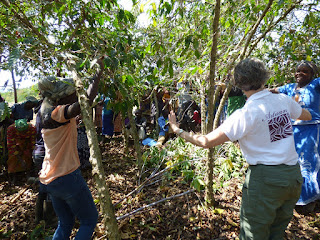
During my field visit yesterday to Sure, where the Ejo Heza women were preparing the land for the next season, they gathered at the end for a short field school lesson on pruning. Agronomist Justin gave a short talk, demonstrating proper pruning technique, then asked Ruth Ann to stand and share some comments. She briefly shared her appreciation for all their work, and announced the number of bags Artisan would be purchasing in the coming year. The women, all 40 - 50 of them, reciprocated with a chant, expressing their dignity and purpose as a group of female coffee farmers. Then they celebrated with several dances and songs! It was loud, joyous and beautiful!

 CLICK HERE to hear the women's mantra (or click photo below).
https://www.youtube.com/watch?v=Fis_OyOC9Zg


CLICK HERE for the very short video (technical difficulties) or click one of the photos below.

https://drive.google.com/open?id=1hSKCFioKuOy-TeqKSYQBEJxugH6AxDkW

https://drive.google.com/open?id=1Zg1X-rKhTYNpkfVkchEuozps-JHwmupc