In this video, I'm interviewing a young teacher I met in Meru, Kenya about the issue of involving women in coffee businesses. It's an issue for Kenya, because coffee production on smallholder farms has been going down. There have been women staging what has been called a "revolt" because their husbands maintain full control over the cash that comes in, while the women do most of the work in the coffee fields. So in some areas, the women have refused to work on the coffee and instead grow bananas or other products. So the household then becomes a dual-cash-crop household. But coffee productivity goes down (the men are not industrious enough) and the women earn much less with bananas than they could with coffee.
Sunday, March 13, 2011

Wednesday, March 9, 2011
Single origin, high-end decaf a reality
Mar. 9, 2011
It's been great to be back in the U.S. and see some new things -- Metropolis (Chicago, IL) has launched a revamped and much revved effort to offer a wide array of single origin coffees. Including decaf! Their character as a roaster includes highlighting some of the softer side of coffee -- click here to see how they've cared enough to share what Artisan Coffee Imports is doing to give back to the communities at origin.
It's been great to be back in the U.S. and see some new things -- Metropolis (Chicago, IL) has launched a revamped and much revved effort to offer a wide array of single origin coffees. Including decaf! Their character as a roaster includes highlighting some of the softer side of coffee -- click here to see how they've cared enough to share what Artisan Coffee Imports is doing to give back to the communities at origin.
Tuesday, March 8, 2011
Kenya-Meru-Riankune Cooperative
 Feb. 24, 2011
Kenya, Meru region
Visit to Riankune Cooperative (and factory), 1400m (5250 ft), East side of Mt. Kenya, Kienganguru District (near Chogoria)
Rainfall: 1,500mm
Temp range: 16-20°C
Members: 360, each with 50 - 1000 coffee trees, harvesting ~130-150kg ea.
2010 production: 128,778 kg
Main harvest period: March-June
Types: 4 types of arabica: K7, SL28, SL34 and some Ruiru 11
Shade: 50% of acreage protected by shade
Andrew Kandia, marketing services agent with SMS, and I arrived about 9:30. First we met the vice-chairman of the society, Ephraiim Nkonge and Edafas Kenegen, the assistant manager. Soon Festus Kariuki, the factory manager, also arrived.
Grafting:
Together we looked at their nursery stock, obeserving how they are grafting SL28 to an SL34 base to create Ruiru11 saplings. Ruiru11 has proven to be more productive than SL28, but somewhat more susceptible to drought.
Farm visit:
As we walked up the hill to visit one of the farms, we met the Chairman of the so
 ciety, Burini Ntaari. This tall, gentleman with glasses and a red sun hat welcomed us with a broad smile. I wish I knew more than my few words of Swahili because Mr. Ntaari did not speak English. He is 90 years old and still ably walked up and down the hills and through the trees with us the whole way. We arrived at the farm of Mr. Ntaari's brother, M'rucha Ntaari. We also met M'rucha's wife, son and his cows and goats. All seemed very happy and comfortable. Their farm grows many other crops and vegetables besides coffee, so it appears they have a diversified income.


Meeting the governing committee:
After touring the farm and the washing station, we met in the chairman's office with the 5 member cooperative board. Each person on the board represents a geographic region and therefore a certain number of farmers. We discussed the coffee Artisan Coffee Imports (my company) had purchased from the cooperative. The Vice-Chairman knew the price paid at the auction and exactly how many bags (it was a 44 bag microlot). The auction price (of $3.46/lb.) was a helpful discussion point to share how the value chain works after the auction. I gave the chairman 3 bags of roasted coffee from my customers, Metropolis and Mighty Good Coffee, and shared how at that point, the coffee is selling for $17-$19/lb. This insight got many interested looks and exclamations among the committee members.
Chairman Ntaari thanked me for the visit, (and the token gift of a Michigan cap), and said he would show the coffee bags to the other farmers to inspire their efforts to produce high quality coffee.


Thursday, February 24, 2011
Day 3 - in Arusha, Tanz. EAFCA

Saturday, Feb. 19
This day ended up having both the typical frustrating and exhilarating experiences of a Western tourist in East Africa. It started out with the frustrating. My hotel, the Impala Hotel in Arusha, had no record that my 3 nights had been paid by my travel agent in Nairobi. They didn't even have a shred of evidence that the agency had placed my hotel reservation. I knew the agent had said they would pay the hotel, but I couldn't stay to argue with the guy, so I paid the hotel with my credit card and got on the shuttle going to the conference. Hours later after I was finally able to get the travel agent to call the hotel, Impala admitted they had been paid 2 days earlier and agreed to refund my credit card the charges for 3 room nights. I got the receipt to prove it.
At EAFCA, I was able to catch the sessions on coffee financing in Africa which included presentations by the Coffee Development Fund, Kenya and Finance Alliance for Sustainable Trade (FAST). The FAST presenter was Noemi Perez, and I was privileged to be able to visit with her for about an hour after her presentation to learn more about what FAST is doing. They are a young, innovative player in the world of development finance and technical assistance.
I enjoyed sharing lunch (which was on the patio near the exhibit booths again) with coffee professionals from Rwanda and Cameroon. Then it was on to visit the Thika Coffee Mills booth. Thika is the miller that processed the Kenya AA Meru-Riankune that my company, Artisan Coffee Imports, is now selling (as decaffeinated green). Later, I got to hear most of the talk by David Griswold (Sustainable Harvest) on transparent trade models, which was the perfect segway as I departed for the airport to go to Kenya.
The airport taxi fee was the other frustrating Westerner experience I had. The hotel had told me the fee would be $50. I asked the driver once we were getting in the car if it could be $43. He readily agreed. I obviously paid too much! Should have started at $25.
Then came the flight from Arusha to Nairobi and the exhilarating things about being in East Africa: 1. meeting Sakina 2. seeing Kilimanjaro's peak from the plane as we flew by! Sakina and I met as we we

 re checking in our luggage. She's a Nairobi native who had just been to a wedding in Tanzania. We talked, got on the plane together and as we did, discovered that she lives in the same neighborhood as the Methodist Guest House where I was going to stay! I invited her to ride with the driver that would be picking me up and she agreed. She canceled her driver. Attached is the best shot I could get of Kilimanjaro. I was sitting next to 2 young British women on the plane who and just climbed it and were cursing it. There had been early and heavy snows, which made the climb very cold, very tiresome (trudging through deep snow) and almost impossible. There's also a shot of the inside of the small airplane. Cozy, eh?
Sunday, February 20, 2011
Day 2 - in Arusha, Tanz. EAFCA

Friday, Feb. 18, 2011
Met interesting folks on the shuttle bus from Arusha town to the hotel where the conference is -- Europeans from the 4C program, the Neumann Stiftung and a Canadian from FAST. The 4C program can be described as "UTZ light". A few years ago, some private companies (including big ones like Nestle and Tchibo), some producers and some funding organizations got together to create a standard of "the basics" for sustainability, fair working conditions and good business practices. The 4C enables producers who are doing a good job (but not yet good enough to get certified) to still differentiate themselves from producers who are using good practices.
The morning session on women in coffee was great. First August Burns from Grounds for Health talked about their recent successes. While I've always thought Grounds for Health was good, I was skeptical because the focus on cervical cancer seemed so narrow -- limited even. After August's talk, I understood better! They are saving women's lives and will reduce the rate of cervical cancer by 30% in the communities where they work. The finale was a great video prepared by IWCA with Burundi women farmers sharing their stories. Very inspiring. Phyllis Johnson's presentation about IWCA used an African proverb as a theme, "if you want to go fast, travel alone; if you want to go far, travel together."
Next was a roundtable session hosted by CQI on "High Coffee Prices - Good o
 r Bad?". How's that for a topic? It drew 8 or 10 tables of 6 each and the session was moderated by Bruce Mullins of Coffee Bean International. The photo shows the list of "goods" and "bads" that was finally distilled out of each small groups' discussions.
The next event was the coffee farm visit. I went on the bus with 20 others to Two Bridges Estate, which was over an hour's drive away, on the other side of Mt. Meru. This was advertised as a "high tech" farm and it was. They have two center pivot irrigation machines on th
 e
e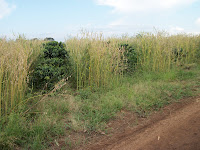 ir large, flat fields with no trees. These make up the "low" farm. Two other farms belong to the same owner, but they are higher up, on slopes and they have shade. The farm also is implementing an innovative inter-cropping method with a plant called sun-hemp. Sun hemp is totally worthless as a grain ("even cows won't eat it" we were told). So it doesn't get stolen, and it's allowed to grow to about 4 ft. tall, then it's felled to just lay on the ground and accomplish 3 things: retain moisture in the soil, fix nitrogen in the soil and fight against nemotodes (a pest).
The washing station at Two Bridges was odd because it was 7km away and up a mountain. They have to truck coffee from the lower farm to the station, and then bring it back down again for storage. The station seemed a little old, but they ran the depulper for us with some buckets of cherries. The equipment and set-up seemed to be running great.
I was invited to a dinner by Schluter at a nearby restaurant. Like the night before, tables were actually out in the open, just under a sturdy tent. The food was excellent and two quality awards were presented.
Thursday, February 17, 2011
Day 1 - in Arusha, Tanzania - EAFCA
Thursday, Feb. 17, 2011
It's been a fine first day in Tanzania. Started out with a typical bad assumption on my part --- namely I believed the hotel manager who told me a shuttle would arrive at 8am that would go to the Ngoroto Hotel where the EAFCA conference is. Wrong. By 8:15am he had changed his story and was telling me and another EAFCA delegate (from Japan) that we would have to pay for our own way out there.
So we got a taxi and that was probably the best thing. I needed to go into town to buy a phone and the taxi driver was very helpful. My new-found Japanese friend helped me negotiate prices, too - we had to buy the phone, then the SIM card, then get minutes on the SIM card then exchange dollars for Tanzanian Schillings. Doing all that afforded a peek into "real life" in Arusha that other conference attendees are not seeing.

Finally, around 10am we were at the beautiful Ngoroto Hotel and Resort and attending the conference. The photo shows me with Mark Stell (Portland Roasting), Elliot from Schluter (CH), Phyllis Johnson (BD Imports). What I love about these conferences is meeting producers like Loy and Jane from Uganda (other photo).
The conference in cluded seminars on expected volumes, pricing and coffee market issues for the coming year. There was, naturally, a lot of focus on East African countries. I was very intrigued by the Nescafe Plan presented by Gary Milsted of Nescafe. The big brand companies are talking like they really want to make a difference at the smallholder level. The exhibit area is refreshingly different -- all the booths are out in the open air!
The dinner this evening was also in the open air (under tents) at the Rivertree Hotel. Very enjoyable company, including roasters from 3 continents, farmers, and CQI professionals.
It's been a fine first day in Tanzania. Started out with a typical bad assumption on my part --- namely I believed the hotel manager who told me a shuttle would arrive at 8am that would go to the Ngoroto Hotel where the EAFCA conference is. Wrong. By 8:15am he had changed his story and was telling me and another EAFCA delegate (from Japan) that we would have to pay for our own way out there.
So we got a taxi and that was probably the best thing. I needed to go into town to buy a phone and the taxi driver was very helpful. My new-found Japanese friend helped me negotiate prices, too - we had to buy the phone, then the SIM card, then get minutes on the SIM card then exchange dollars for Tanzanian Schillings. Doing all that afforded a peek into "real life" in Arusha that other conference attendees are not seeing.

Finally, around 10am we were at the beautiful Ngoroto Hotel and Resort and attending the conference. The photo shows me with Mark Stell (Portland Roasting), Elliot from Schluter (CH), Phyllis Johnson (BD Imports). What I love about these conferences is meeting producers like Loy and Jane from Uganda (other photo).

The conference in
 cluded seminars on expected volumes, pricing and coffee market issues for the coming year. There was, naturally, a lot of focus on East African countries. I was very intrigued by the Nescafe Plan presented by Gary Milsted of Nescafe. The big brand companies are talking like they really want to make a difference at the smallholder level. The exhibit area is refreshingly different -- all the booths are out in the open air!
The dinner this evening was also in the open air (under tents) at the Rivertree Hotel. Very enjoyable company, including roasters from 3 continents, farmers, and CQI professionals.
Wednesday, February 16, 2011
Transferring in Amsterdam
Ah. The single shot of Segafredo espresso is kicking in as I sit on this comfy orange sofa-bench in Schiphol (Amsterdam) airport. No decaf espresso here. I asked.
Flight to Kilimanjaro, Tanzania departs in 2 hrs. Should be a fair crew of coffee folks headed to the EAFCA conference on that flight. Saw Anne Ottaway as I was boarding in Detroit. It's her 3rd trip to Africa this year already!
Flight over was pleasant. Met a charming Irish man living in Bergen, Norway. Cancer researcher. He showed me pictures of the beautiful landscape of fjords and mountains around his home. He's a bike commuter and cross-country skiier, too. Loves Norway. Discussion about Norwegian tax structure and culture was interesting. Would love to go there again. (It was 25 years ago that I backpacked there - yikes!)
Logging out now since it's 3 Euro for 15 mins in expensive Europe.
Flight to Kilimanjaro, Tanzania departs in 2 hrs. Should be a fair crew of coffee folks headed to the EAFCA conference on that flight. Saw Anne Ottaway as I was boarding in Detroit. It's her 3rd trip to Africa this year already!
Flight over was pleasant. Met a charming Irish man living in Bergen, Norway. Cancer researcher. He showed me pictures of the beautiful landscape of fjords and mountains around his home. He's a bike commuter and cross-country skiier, too. Loves Norway. Discussion about Norwegian tax structure and culture was interesting. Would love to go there again. (It was 25 years ago that I backpacked there - yikes!)
Logging out now since it's 3 Euro for 15 mins in expensive Europe.
Subscribe to:
Posts (Atom)