Feb. 10, 2019
During my visit to the Ruli Mountain washing station owned by Land of One Thousand Hills (LOTH), I had the delightful opportunity to interview two farmers. They belong to the approximate 1,200 farmers who deliver cherry to this washing station, which collected 451,000 Kg cherry in 2018. Maceline (age 40) and Mary (age 36) were kind enough, through my interpreter, to accept an invitation from the washing station manager to be interviewed on the date of my visit. My objective was simply to provide a snapshot of "who is a farmer?" at one of LOTH's washing stations.
Maceline M:
Age: 40
# of Children: 3 - one of which was there for the interview. Charming "Mick."
# of coffee trees: 100 - shared ownership with husband. These trees were purchased in 2011.
Started coffee farming: 25 years ago with her family when she was a child.
% of income from coffee: 50%
Cherry price: In 2017 she remembers receiving 320 Rwf/Kg cherry.
She got the 100 seedlings she and her husband own from LOTH. Now coffee is a source of income and development for her family. They also grow beans, soya, maize, sweet potato, banana, casava and vegetables. She says she and her husband decide together about how to spend the income from coffee. Everyone in her family participates in delivering coffee cherry to the washing station.
Mary M:
Age 36
Children: 3
# of coffee trees: 840 total; 420 were planted 5 years ago; another 420 were planted just 3 years ago and so the very first harvest was 2018. She received the seedlings 3 years ago from a LOTH program.
Cherry price: in 2018 it was 280 Rwf/kg cherry. In 2017 it was 320.
They have found that good things come from coffee. Income to pay Mituel health insurance and solve other issues. The coffee money is a lot, but it spends quickly! Her family also grows bananas, casava, beans, vegetables and maize. She explained that is can be either her or her husband who comes to the washing station to receive the coffee payments. They hope that they can get 300 Rwf/kg cherry again this year. This would mean they earn a small profit.
We talked about the practices they are using on their coffee fields. When it came to the topic of mulch, they both complained about the high cost and the difficulty to access mulch. I asked them to help me understand what "expensive" means. They explained that first they often have to travel far away from the plot to find a place with mulch grasses growing. Then they are charged (for a swath of land they indicate with their hands) 80,000 rwf for the grass itself; 20,000 rwf for the labor (they do not do the cutting alone); 20,000 rwf to the land owner (service fee); and 20,000 rwf for transport. In total: 140,000 Rwf ($157) for that day's mulch delivery.
Themes related to roasters and the direct-trade coffee offered by Artisan Coffee Imports
Showing posts with label #womenincoffee. Show all posts
Sunday, February 10, 2019
Friday, June 29, 2018
Ejo Heza Women Dancing During Field School
June 29, 2018
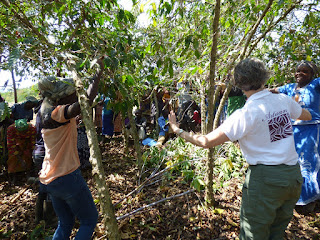
During my field visit yesterday to Sure, where the Ejo Heza women were preparing the land for the next season, they gathered at the end for a short field school lesson on pruning. Agronomist Justin gave a short talk, demonstrating proper pruning technique, then asked Ruth Ann to stand and share some comments. She briefly shared her appreciation for all their work, and announced the number of bags Artisan would be purchasing in the coming year. The women, all 40 - 50 of them, reciprocated with a chant, expressing their dignity and purpose as a group of female coffee farmers. Then they celebrated with several dances and songs! It was loud, joyous and beautiful!
CLICK HERE to hear the women's mantra (or click photo below).
CLICK HERE for the very short video (technical difficulties) or click one of the photos below.
During my field visit yesterday to Sure, where the Ejo Heza women were preparing the land for the next season, they gathered at the end for a short field school lesson on pruning. Agronomist Justin gave a short talk, demonstrating proper pruning technique, then asked Ruth Ann to stand and share some comments. She briefly shared her appreciation for all their work, and announced the number of bags Artisan would be purchasing in the coming year. The women, all 40 - 50 of them, reciprocated with a chant, expressing their dignity and purpose as a group of female coffee farmers. Then they celebrated with several dances and songs! It was loud, joyous and beautiful!
CLICK HERE for the very short video (technical difficulties) or click one of the photos below.
Saturday, June 23, 2018
What Bette UWIMANA would like to tell you...
![]() |
| Bette Uwimana, one of the leaders of Ejo Heza. |
Aaron asked, "what would you like to tell our customers who drink your coffee?"
CLICK HERE to open a Youtube video and listen to Uwimana's answer in her own words (translated from Kinyarwanda to English by Gervais Kayitare).
Brief summary: "what I can say to our clients is that we hope they continue to build their relationships with our farmers so that we can increase our production. Another thing, we will continue to receive their advice related to the quality of our coffee."
![]() |
| L: Kayitare, R: Uwimana |
![]() |
| L: Uwimana, R: Van der Groen |
![]() |
| L: Church, R: Uwimana |
Monday, June 11, 2018
Roaster of the week: Blueprint - Telescopes and Microscopes
![]() |
| Blueprint team meeting - front of store! |
![]() |
| Blueprint Logo |
Blueprint's overall Green Buying Partnership Vision is to promote shared risk and improved data sharing between the producers and Blueprint Coffee, creating a kind of "telescope" from the cafe counter in St. Louis, Missouri, to six inches into the soil of every farm growing their coffee! It's not every day that you meet people who are so into coffee, that soil is as interesting as outer space! But that is the case with Timko, Razani, Reddy and Marquard. And it actually makes a lot of sense when you hear someone like Timko explain it. "Coffee quality doesn't start with the bean, it starts with the soil the coffee plant is growing in."Timko describes his vision of having digital tools that allow him as a roaster in St. Louis, to get regular readings on soil moisture and soil micro-organism counts on the farms that grow the coffee they buy half a globe away - year 'round. They may be a few years away from that being a reality, but they are definitely working towards it step by step.
The focus on brewed cup quality and a chill space to relax and enjoy coffee is equally strong. They've won awards from Good Food Awards for one of their single-origin coffees and from Architectural Digest for their space.
Blueprint's search for authenticity in everything they do is literally what led them to Artisan Coffee as their importer for Rwandan coffee. Timko was trying to understand the history of specialty coffee in Rwanda and stumbled onto the story of the PEARL project, which launched Rwanda's rise in the coffee world in 2003. This led him to Michigan State University websites, which eventually led him to get in touch with Ruth Ann Church, who was studying under the director of the PEARL project (Dan Clay) recently. Her "student profile" mentioned she is a coffee importer.
So five years after the fabled start of Blueprint, amazing projects are gearing up. One involves a microscope. It seems a microscope would be more beneficial than a telescope for the women of Ejo Heza, the sub-group at Kopakama cooperative that grows the coffee Blueprint buys. Watch this space, as the concept of a great cup of coffee may include helping coffee farmers monitor their soil with microscopes!

Labels:
#MakeCoffeeBetter,
#womenincoffee,
Blueprint Coffee,
Rwanda Ejo Heza,
soil health,
soil microbiology
Location:
St. Louis, MO, USA
Monday, April 30, 2018
Roaster of the week: Kristina Madh - Cloudland Coffee
Roaster Kristina Madh and I connected on several levels when we met at CoffeeFest Baltimore.
I was amazed with her story of opening her micro-roaster company, Cloudland, in Atlanta, Georgia on pure guts, passion and inspiration! She found a space in a shared kitchen where the other entrepreneurs, bakers and other culinary folks, don't mind the aroma of roasted coffee in the air. Then she found customers at the farmers market, on the web, and elsewhere in town. Her customers are people who seek out great-tasting coffee and appreciate businesses like Cloudland, which source their coffee with care for social consciousness and positive impact for the producers who grow the coffee. "Fair trade and beyond" is one way to put it.
Kristina puts it this way on Clouldland's website: We strive to responsibly source our coffee from importers who engage
with coffee farmers through programs including Fair Trade, Sustainable
Farming Practices (including organic farming), the Women Coffee
Producers program and more. Our coffee comes from smaller lots and is
seasonal, so you will see a rotation of our coffee throughout the year.
The fact that the producers of this Rwandan coffee are the women of the Ejo Heza cooperative adds an extra "sweet note" for Kristina to this coffee's fruity, berry-like flavors. As a female roaster, she has experienced how the male-dominated coffee industry can ignore women's skills and contributions, but she has also seen how the industry as a whole is moving fast to embrace and empower female professionals in the supply chain. Kristina and I are both proud that this coffee is an example of this good direction, given the traceability to females at the farm, and at the importing, roasting and brewing stages. Way to go, Cloudland!
As Kristina serves up this aromatic coffee at the Farmer's Market in Atlanta, her customers tell her they love the cup! Many also love the story and the satisfaction that Kristina can assure them that the coffee producers received their premium payment. (Click here for a throwback post on that topic.)
![]() |
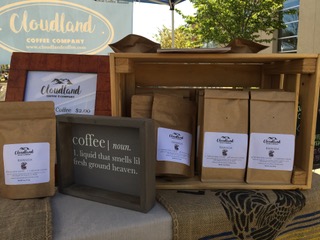
| Serving and showing Rwandan beans. |
I was amazed with her story of opening her micro-roaster company, Cloudland, in Atlanta, Georgia on pure guts, passion and inspiration! She found a space in a shared kitchen where the other entrepreneurs, bakers and other culinary folks, don't mind the aroma of roasted coffee in the air. Then she found customers at the farmers market, on the web, and elsewhere in town. Her customers are people who seek out great-tasting coffee and appreciate businesses like Cloudland, which source their coffee with care for social consciousness and positive impact for the producers who grow the coffee. "Fair trade and beyond" is one way to put it.
The fact that the producers of this Rwandan coffee are the women of the Ejo Heza cooperative adds an extra "sweet note" for Kristina to this coffee's fruity, berry-like flavors. As a female roaster, she has experienced how the male-dominated coffee industry can ignore women's skills and contributions, but she has also seen how the industry as a whole is moving fast to embrace and empower female professionals in the supply chain. Kristina and I are both proud that this coffee is an example of this good direction, given the traceability to females at the farm, and at the importing, roasting and brewing stages. Way to go, Cloudland!
As Kristina serves up this aromatic coffee at the Farmer's Market in Atlanta, her customers tell her they love the cup! Many also love the story and the satisfaction that Kristina can assure them that the coffee producers received their premium payment. (Click here for a throwback post on that topic.)
![]() |
| Rwanda packaged - who wouldn't want to buy some heaven?! |
![]() |
| Farmers' market display. |
Labels:
#womenincoffee,
Alpharetta GA,
Atlanta Georgia,
Cloudland Coffee,
Kristina Madh,
Rwanda Ejo Heza,
womens coffee
Location:
Alpharetta, GA, USA
Subscribe to:
Posts (Atom)